Building a lightweight inference gateway for connected language systems
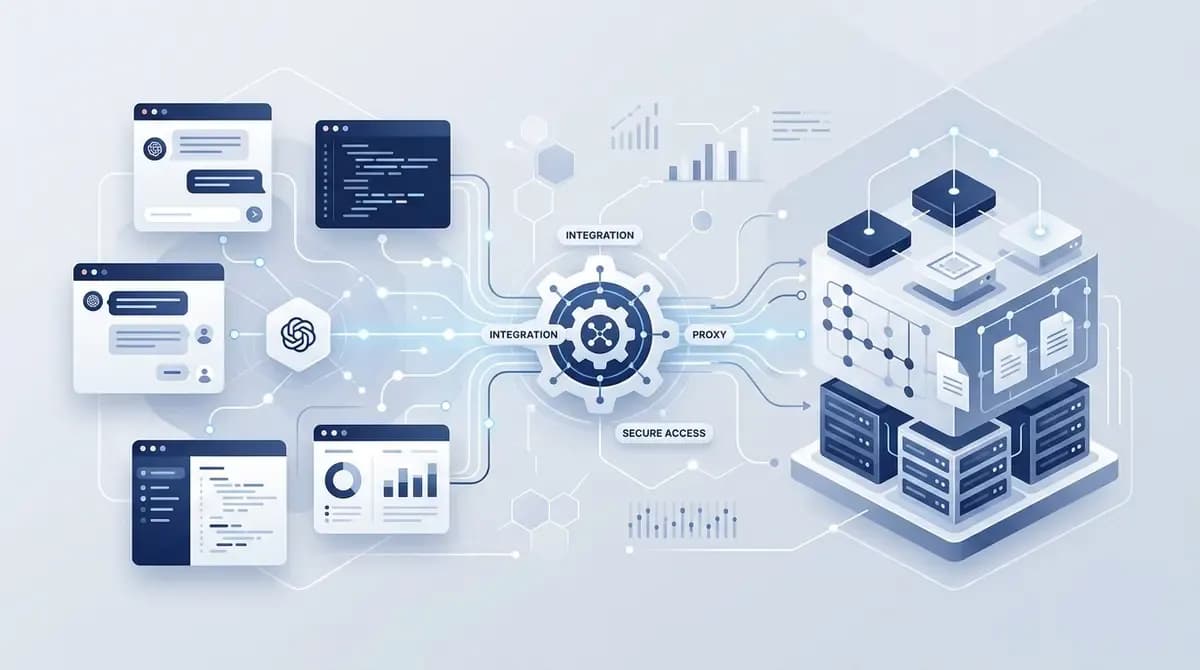
Connected language systems need more than a model endpoint. They need a reliable way to receive requests, retrieve trusted context, call external tools, enforce access rules, and return predictable responses without adding unnecessary infrastructure.
A lightweight inference gateway provides that control layer. It sits between AI clients and language models, APIs, documentation, and business systems, making connections easier to operate while keeping latency, cost, and complexity under control.
Define the gateway’s core responsibilities
The first step is to keep the gateway focused. Its primary responsibilities should include request routing, authentication, context assembly, model invocation, response formatting, and observability. Anything outside that boundary should be added only when it solves a clear operational problem.
A gateway for connected language systems should expose a stable interface even when underlying models or data sources change. This abstraction lets product teams switch providers, introduce new models, or update internal APIs without forcing every client integration to change at the same time.
Protocol support also matters. A gateway can expose hosted Model Context Protocol servers for websites, documentation, and APIs, allowing compatible AI clients to discover and use capabilities through consistent endpoints. This turns scattered resources into controlled, reusable context sources.
Design a low-latency request path
Latency is shaped by every operation in the request path: network negotiation, authentication, retrieval, tool execution, model inference, and response serialization. Measure each stage separately instead of treating the model as the only source of delay.
Keep the hot path small by reusing connections, applying sensible timeouts, and avoiding unnecessary transformations. Streaming responses can improve perceived performance by delivering tokens as they are generated rather than waiting for the complete answer.
Context retrieval should be selective. Fetch only the documents, API results, or tool outputs required for the current task, and cache stable resources where appropriate. A compact context window generally improves both response speed and answer quality.
Build secure context and tool access
Connected systems expand what a language model can see and do, so access control must be enforced before tools execute. Use scoped credentials, tenant-aware authorization, and explicit permissions for each endpoint, data source, and operation.
Do not rely on model instructions to protect sensitive actions. The gateway should validate parameters, apply allowlists, redact secrets, and reject requests that exceed policy. High-impact operations should support approval workflows or require an additional verification step.
External content should be treated as untrusted input. The gateway can reduce prompt injection risk by separating system instructions from retrieved data, labeling source content, filtering unexpected commands, and limiting which retrieved fields are passed to tools or models.
Make the gateway observable and dependable
Operational visibility should be built in from the beginning. Record request latency, model usage, token counts, tool calls, error categories, cache performance, and upstream response times. These signals make it possible to identify bottlenecks before users report them.
Logs must balance debugging value with privacy. Avoid storing raw prompts or sensitive tool results by default, and provide configurable retention, redaction, and access controls. Correlation IDs allow teams to trace a request across the gateway, model provider, and connected services.
Reliability comes from controlled failure. Set timeouts for every upstream dependency, retry only safe operations, use circuit breakers for failing providers, and return structured errors that clients can handle. Versioned endpoints and health checks also make deployments safer.
Scale without losing simplicity
A lightweight gateway should scale horizontally with stateless application instances wherever possible. Store durable configuration, usage records, and version metadata in managed services, while keeping transient request state short-lived and easy to discard.
Autoscaling should reflect more than request count. Concurrent streams, token throughput, tool execution time, and provider rate limits can all become constraints. Queue work that can tolerate delay, and protect interactive requests from expensive background operations.
Operational simplicity is a feature. Managed hosting, automatic scaling, endpoint versioning, and centralized configuration reduce the maintenance burden for engineering teams and agencies. The goal is not to recreate a full platform internally, but to provide a dependable connection layer that can evolve with demand.
A well-designed inference gateway turns model access and external context into a controlled system rather than a collection of fragile integrations. By keeping the request path focused, securing every tool boundary, and exposing useful operational signals, teams can move quickly without sacrificing reliability.
The strongest implementation is usually the smallest one that meets current requirements and leaves room for growth. Start with clear protocols, hosted endpoints, strict policies, and measurable performance. Then expand capabilities only when real workloads demonstrate the need.