How orchestration platforms and connector ecosystems shape autonomous assistants
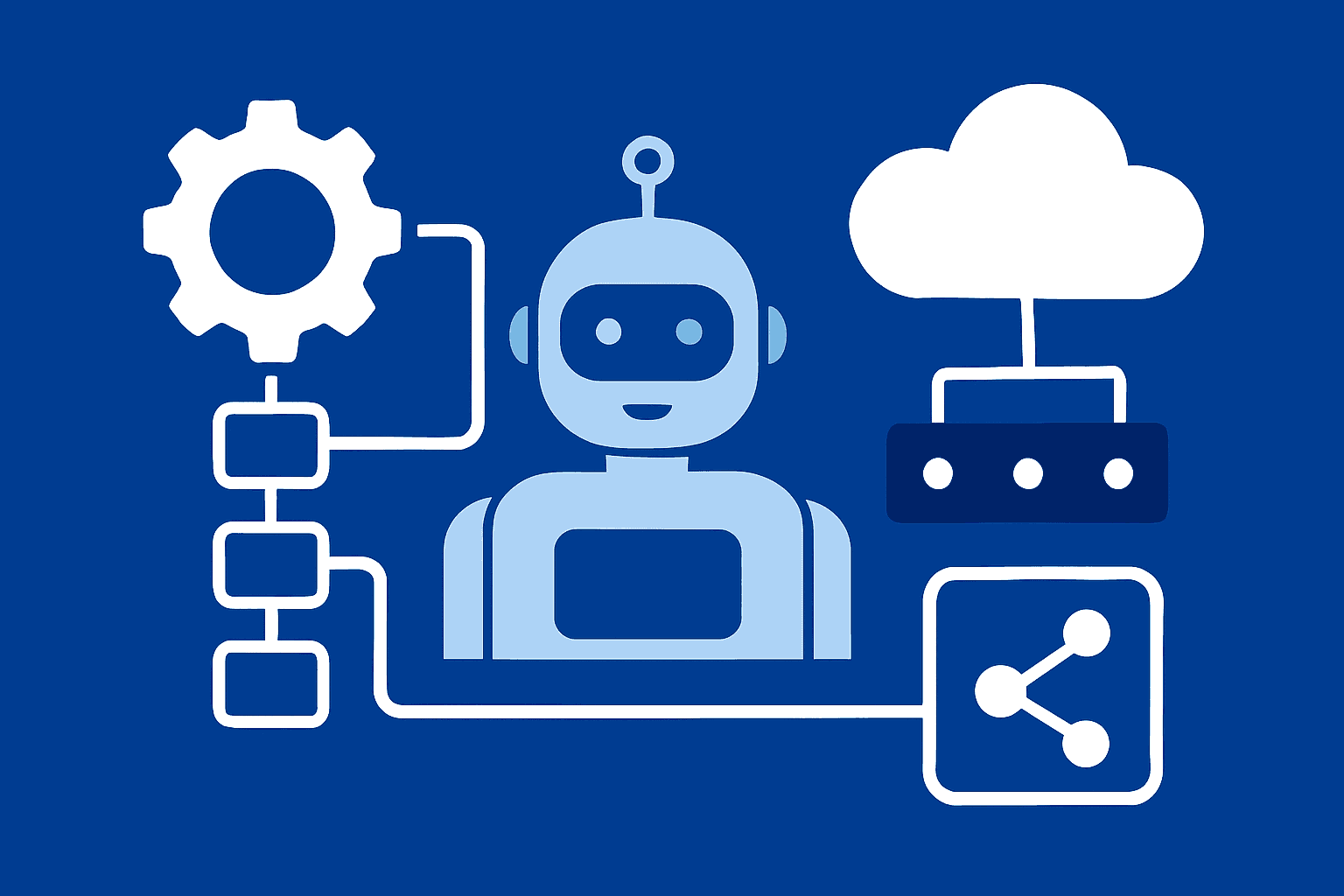
Autonomous assistants fail to deliver value when they can generate a plausible answer but cannot find approved company context, choose the right action, or carry work safely across several systems. Autonomous assistant orchestration is the layer that turns a model into an operating system for work: it coordinates decisions, tools, memory, data access, and human review.
The practical shift is clear across major platforms. Orchestration is no longer merely a routing feature between prompts and APIs, while connectors are no longer optional add-ons. Together, they determine whether an assistant can complete a governed business process or remains a useful but isolated chat interface.
What autonomous assistant orchestration does in a production stack
In a production assistant, a language model is one component, not the complete application. It can interpret a request and propose a next step, but it needs a controlled way to retrieve information, invoke tools, preserve task state, recover from failures, and decide when a person should take over.
AWS describes the agents layer as a central coordination hub for users, models, tools, and knowledge sources. Its orchestration mechanisms enable agents to reason, call tools, retrieve knowledge, and maintain memory. That definition captures why orchestration has become a control plane: it governs how the rest of the assistant system works together.
Direct answer: Orchestration platforms shape autonomous assistants by controlling how they plan, route work, use memory, call tools, coordinate subagents, and request human review. Connector ecosystems shape them by supplying governed access to the business data and actions that make those plans useful.
This distinction matters because a tool call alone does not equal autonomy. An assistant that can open a ticket, read a customer record, or query a knowledge base still needs policies for deciding whether to act, what information to use, what sequence to follow, and how to record the result. Orchestration provides that decision and execution structure.
Planning and routing:
choose a workflow, agent, model, tool, or retrieval method for the task.
State and memory:
keep track of task progress, previous decisions, inputs, and relevant context over time.
Tool governance:
apply permissions, parameters, confirmation rules, and error handling when an assistant acts.
Coordination:
delegate bounded work to subagents or external systems and combine their outputs.
Supervision:
expose checkpoints where people can inspect, correct, approve, or reject meaningful actions.
Google Cloud makes a similar architectural separation in Gemini Enterprise. Its Agent Development Kit supports code-first development of complex agents and orchestration logic, while connector tools let agents act through configured Integration Connectors. Separating those roles helps teams avoid a common design mistake: treating workflow control and external-system access as the same problem.
Why connector ecosystems make assistants context-aware and actionable
An assistant cannot reliably help with internal work if its context ends at the chat window. Connector ecosystems provide a managed path into the systems where the organization’s current facts, workflows, and records live. Depending on permissions and configuration, those systems may include knowledge repositories, work-management tools, customer platforms, collaboration spaces, and internal applications.
OpenAI’s 2025 enterprise report describes leading firms enabling connectors so AI can securely access data inside core tools. The result is not simply a larger corpus for answering questions. It is context-aware responses and, where the integration permits it, automated actions inside the systems where employees already work.
Access is more valuable when it is governed
More connected data does not automatically mean a better assistant. The assistant needs access that reflects existing identity, authorization, data handling, and audit requirements. A connector ecosystem is valuable because it can make integrations repeatable, but every connector must still be evaluated for the data it exposes and the actions it permits.
Google Cloud’s connector guidance illustrates that operational constraints are part of the architecture. Connector tools must match the agent’s location. This is a concrete reminder that connectors are not an abstract capability layer; deployment location and platform configuration can constrain which architectures are viable.
Teams should therefore distinguish three types of connector access:
Read access
gives an assistant grounded context for search, retrieval, summarization, and decision support.
Write access
lets it create or update records, messages, tasks, and other business objects.
Execution access
enables a connector or tool to trigger downstream operations, often carrying greater operational risk.
The permission model should become more deliberate as the assistant moves from reading to changing systems. An assistant that summarizes a case file and one that closes the case may rely on the same connector, but they should not necessarily have the same authorization, workflow, or approval design.
Connector coverage can be an adoption constraint
Model quality receives most of the public attention, but missing access to enterprise context can be the more immediate constraint. OpenAI reports that roughly one in four enterprises had not enabled connectors. That means a meaningful share of organizations may be limiting assistant usefulness not because a model cannot reason over a task, but because the assistant cannot reach the information and systems needed to do the work.
This is why sophisticated organizations increasingly embed API-powered assistants into internal systems rather than asking employees to transfer context manually into a standalone chat. The connector layer reduces manual handoffs, but only if it is implemented with careful access boundaries and predictable operational ownership.
How workflow orchestration enables long-running autonomous assistants
Short tasks can sometimes be handled with a simple retrieve-and-answer pattern. Long-running work is different. A request may require multiple decisions, dependencies between systems, conditional branches, retries, delegation, and a final handoff to a person. These are workflow problems as much as they are model problems.
AWS says workflow orchestration agents manage multistep tasks and can delegate work to subagents or other systems. This is especially useful for long-running tasks, multi-agent compositions, and conditional integrations. In other words, an assistant can be designed to manage a process rather than merely generate one next response.
From chat turns to durable task state
Consider a request to investigate an account issue. A durable assistant may need to identify the account, retrieve service history, inspect open cases, check internal guidance, determine whether an action needs approval, create follow-up work, and report what happened. Each step produces state that the next step must use.
Without orchestration, that sequence often becomes a fragile chain embedded in prompts or application code. With an orchestration layer, teams can model steps, expected inputs, allowed tools, branch conditions, and recovery paths more explicitly. This does not guarantee correctness, but it makes the operating logic more inspectable and maintainable.
A retrieval step can gather approved context before the assistant recommends an action.
A policy step can determine whether the assistant may act directly or must request approval.
A tool step can create, update, or route work through a connected system.
A verification step can check the outcome before the assistant reports completion.
A handoff step can preserve relevant context when human intervention is required.
Google Cloud’s February 2026 guidance frames production-ready agents as systems requiring memory, orchestration, security, and tool selection, not only model quality. That framing is useful because it pulls teams away from a narrow question,“Which model should we use?”,and toward the broader question: “What operating system does this assistant need to behave safely and reliably?”
The limit is equally important. Orchestration does not remove the need for clear process design. If the underlying workflow is ambiguous, its exception paths are unknown, or ownership is disputed, adding agents can amplify confusion. Start with a bounded process that has known inputs, explicit outcomes, and an accountable business owner.
Multi-agent coordination changes the control-plane requirements
As assistants become more capable, a single agent does not need to perform every task itself. One agent may gather evidence, another may prepare an action, and a third may check whether the output satisfies policy. The resulting design can improve specialization, but it also creates a coordination challenge: who assigns work, tracks progress, resolves conflicts, and presents results for review?
OpenAI’s 2026 Symphony offers a visible example of this shift. OpenAI describes it as an agent orchestrator that turns Linear into a control plane for coding agents, where every open task gets an agent and humans review results. The notable point is not just parallel task execution; it is the use of a familiar project surface to manage a fleet of agents.
That approach responds to a changing bottleneck. OpenAI argues that the bottleneck is moving from task execution to context switching. When numerous autonomous tasks are active, people need an effective way to understand status, priorities, dependencies, outputs, and exceptions without continuously reconstructing context from scattered conversations and logs.
Supervision must be designed into the workflow
OpenAI’s 2026 Warp writeup links orchestration with supervision and verification as agents become more autonomous. This is the right design principle for agent fleets. Autonomy should increase the quality and speed of execution, not erase visibility into what is being done.
Useful supervision is not a generic final approval on every task. It is a deliberate set of controls matched to the consequence of each step:
Reviewable plans
let people inspect proposed work before consequential execution begins.
Scoped delegation
restricts each agent or subagent to a defined responsibility and permitted tool set.
Verification checkpoints
test an output or tool result before a workflow advances.
Exception queues
send ambiguous, failed, or policy-sensitive cases to the right human owner.
Traceable outcomes
preserve enough task history for a reviewer to understand what the system did and why.
A multi-agent design is not automatically better than a single well-orchestrated assistant. It adds coordination over and can make diagnosis harder if responsibilities overlap. Use multiple agents when decomposition creates a meaningful boundary,such as distinct expertise, independent verification, or parallelizable work,not merely because agent specialization sounds advanced.
Standard protocols and connector marketplaces reduce bespoke integration work
The fastest way to make an assistant brittle is to hard-code every tool integration into an individual application. That approach can work for an early proof of concept, but it becomes difficult to govern and reuse as tool counts, agent counts, and business requirements grow.
Connector ecosystems offer an alternative: a shared integration layer through which assistants can gain access to pre-built or custom capabilities. Anthropic says Claude can connect to pre-built web connectors from launch partners as well as connectors built by other companies or by customers’ own organizations through remote MCP. This makes extensibility a platform capability rather than a sequence of one-off integrations.
Protocols matter as much as marketplaces. AWS Prescriptive Guidance recommends architectures that support agent-to-agent communication through standardized protocols such as MCP and A2A, along with state sharing, isolation, authentication, and permissions verification. The direction is toward networks of interoperable tools and agents rather than bespoke point-to-point links.
Portability is an architectural goal, not a guarantee
Standard protocols can reduce lock-in because they create more consistent ways for agents to discover and use external capabilities. They can also help teams preserve a separation between orchestration logic and tool-specific implementation. In principle, this makes it easier to add or replace compatible components without rebuilding every workflow.
However, protocol support does not make integrations identical. Connectors still differ in their data models, action semantics, authentication requirements, regional or location constraints, and error behavior. A portable architecture therefore means minimizing unnecessary coupling, not assuming that every connected tool can be swapped without work.
When evaluating a connector ecosystem, focus on operational questions rather than the size of a catalog alone:
Can the connector enforce the organization’s identity and permission model?
Does it expose the required read, write, or execution capabilities at an appropriate scope?
Can the orchestration layer observe tool outcomes and handle errors or incomplete results?
Does the deployment model meet location and platform requirements?
Can the same integration be reused across more than one assistant or workflow?
These questions put the decision where it belongs: on the reliability and governance of the operating system around the model.
Configuration-led platforms make orchestration more accessible
For many teams, the historical cost of orchestration was custom code: tool loops, state machines, prompt chains, retry behavior, and bespoke agent coordination. That work can be necessary for highly specialized applications, but it creates an implementation burden that slows deployment and makes consistency difficult across projects.
AWS is pushing toward configuration-led orchestration with Amazon Bedrock AgentCore harness. At AWS Summit New York 2026, AWS said the service is generally available for building and running production-grade AI agents without coding orchestration loops, using configuration for models, tools, skills, and instructions. AWS also announced native data connectors, Smart Parsing for multi-format preparation, and an Agentic Retriever for complex multi-step queries.
This product direction changes who can build reliable assistants and how quickly teams can standardize. It does not eliminate engineering work. Teams still need to define policies, choose valid tools, map permissions, test exception behavior, and operate the systems over time. But configuration can move recurring orchestration concerns into a consistent platform layer.
Amazon Connect provides another signal that orchestration is becoming a productized assistant capability. Its documentation lists an Orchestration system AI agent alongside answer recommendation, manual search, self-service, email response, note taking, and case summarization. Orchestration is explicitly an AI agent type that can be associated with flows and customized for response behavior.
Choose configuration or custom code based on the control you need
Configuration-led platforms are well suited to repeatable patterns where teams benefit from governed defaults and faster assembly. Code-first orchestration can be a better fit when a workflow needs unusual control logic, specialized state handling, or deep integration behavior that a platform abstraction does not expose.
Many organizations will use both. The productive question is not whether no-code configuration or code is categorically superior. It is which layer should own which concern: use platform configuration where it standardizes common controls, and use custom development where the business process genuinely requires differentiated behavior.
Reusable orchestration patterns become organizational assets
The most durable assistant programs do not treat every use case as a fresh prototype. OpenAI’s deployment guidance advises teams to identify recurring patterns, including orchestration flows and data assets, that can support multiple use cases and reduce delivery time across future builds.
This is a major organizational implication of the control-plane model. A good orchestration flow is not just implementation detail. It can become a reusable asset, much like an identity pattern, an API standard, a component library, or a data product.
Patterns worth standardizing
Standardization should target repeatable operational controls, not force all assistant experiences into the same conversation design. A useful shared library can include:
approved retrieval and citation patterns for internal knowledge;
connector onboarding requirements and permission-scoping practices;
human-review patterns for high-consequence actions;
task-state, escalation, and retry conventions for long-running work;
evaluation scenarios for tool selection, workflow completion, and failure handling;
agent-to-agent communication boundaries using supported protocols.
Reusable data assets matter alongside reusable flows. If several assistants need the same policy content, customer definitions, or product knowledge, the organization benefits from preparing that information once with clear ownership and access rules. Native connector capabilities and document-preparation features can help, but accountability for the underlying content remains a business responsibility.
Teams should also assign ownership across the stack. A business owner defines the intended outcome and acceptable exceptions. A platform or engineering owner manages orchestration, integration quality, and operational observability. Security and data stakeholders define the access conditions. Without these roles, a connector-rich assistant can become everyone’s experiment and no’s responsibility.
A practical blueprint for building an orchestrated assistant ecosystem
Organizations do not need to begin with an agent fleet or a large connector marketplace. A more reliable path is to start with one workflow where data access, tool use, and human supervision each have a clear purpose. Build the control plane around that workflow, then reuse what proves stable.
Select a bounded outcome.
Define what the assistant should complete, what counts as success, and where it must stop. Avoid starting with an undefined goal such as “automate support” or “make employees more productive.”
Map the required context and actions.
Identify the systems of record, the information the assistant needs, and the actions it may be allowed to take. Classify each connection as read, write, or execution access.
Design the orchestration flow.
Specify the sequence of retrieval, reasoning, tool calls, verification, escalation, and completion. Include conditional paths for missing information, failed tools, and uncertain outcomes.
Set permissions and deployment constraints early.
Connector availability, agent location, identity, and approval conditions can reshape the feasible design. Treat them as requirements, not a late implementation detail.
Define human supervision.
Decide which actions need pre-approval, which need post-action review, and which should always route to a person. Make the review surface useful by showing task status, evidence, and tool outcomes.
Test the system behavior, not just the answer text.
Evaluate whether the assistant selected the right tool, respected permissions, maintained state, handled failures, and stopped when it should.
Promote reusable components.
Turn successful connector configurations, workflow patterns, evaluation cases, and governance controls into assets for the next use case.
Use this blueprint to choose platform capabilities deliberately. A simple assistant may require one orchestrator, one or two connectors, and a clear escalation path. A persistent assistant operating across many systems may need more structured memory, workflow management, multi-agent coordination, and a project-style supervision interface. Complexity should follow the work, not the hype.
The core design principle remains stable: orchestration governs execution, while connectors provide the context and action surface. When these layers are separated but intentionally integrated, teams can improve an assistant without turning every change into a full rebuild.
Key takeaways for autonomous assistant platforms
Autonomous assistants are becoming systems of systems. They combine memory, tool routing, enterprise data connectors, workflow logic, human review, and sometimes multiple specialized agents. The competitive and operational difference will increasingly come from how well those components are coordinated, observed, and governed,not from a model in isolation.
Build for useful autonomy rather than maximum autonomy. Start with trusted connectors, explicit orchestration, scoped permissions, and meaningful review points; then reuse the flows and data assets that work. That approach gives an assistant ecosystem room to grow while keeping execution tied to real business context and accountable human control.